Kicker
The kicker is the specialist who kicks field goals, extra points and kickoffs. A field goal earns three points and an extra point earns one, so a reliable kicker can decide close games. His kickoffs also decide where the other team’s offense starts.
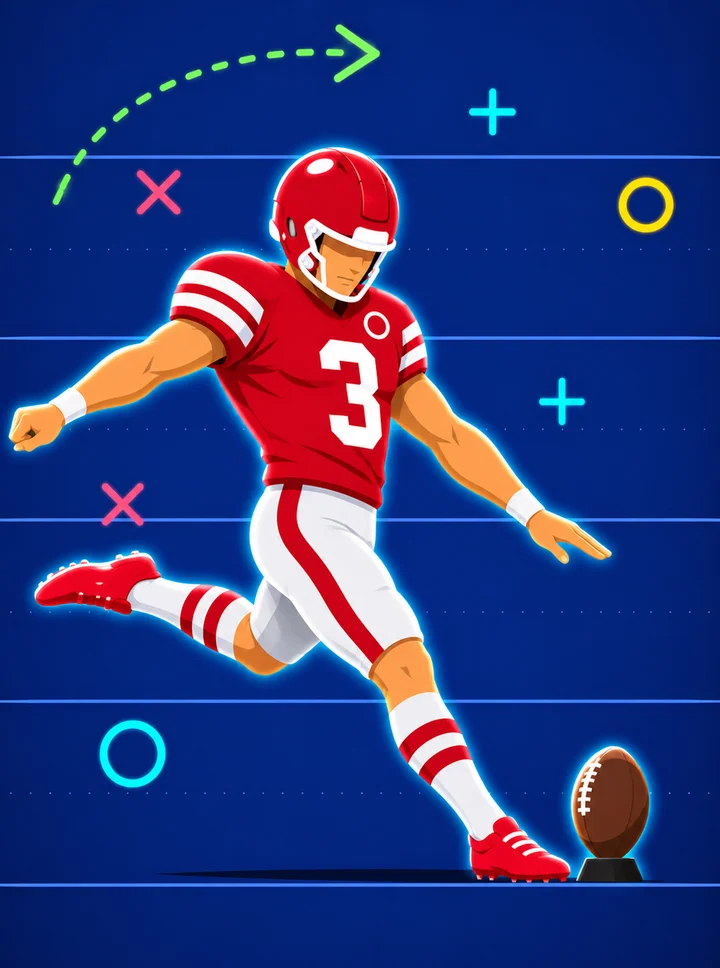
What he does
- Kicks field goals and extra points from the ground, with the holder placing the ball
- Kicks off at the start of each half and after every score
- Chooses the kind of kickoff the situation needs: deep for distance, high for hang time, or short and tricky for an onside kick
- Repeats the same steps and plant on every kick, so the contact with the ball is the same each time
- Works with the holder and the long snapper as a unit, because the whole kick takes only a little over a second
- Handles wind, weather and pressure, since he often kicks at the end of a game
On field goals and extra points
The kicker stands a couple of steps behind and to the side of the holder. When the long snapper’s snap reaches the holder, the holder sets the ball down with the laces toward the goalposts, and the kicker takes his steps, plants his non-kicking foot beside the ball and kicks through it. Because the whole sequence is so quick, any delay gives the defense time to block the kick.
On kickoffs
On a kickoff the ball is kicked from a tee, and the kicker decides the height and the direction. A deep kick makes the returner start farther from the end zone, while a high kick gives the coverage team time to run downfield and tackle him. When the team is losing late in a game, the kicker may try an onside kick, a short kick that his team tries to recover.
What makes a good one
Accuracy and a repeatable motion matter more than raw strength, although enough range is needed too. A good kicker has a calm mind, because he has only a few seconds to make the kick with thousands of people watching. He also needs good judgment about the wind and the field.
How he lines up
The kicker lines up about eight yards behind the line of scrimmage, a few steps to the side of the holder, who kneels about seven yards back. He marks his steps on the grass so that his approach is the same every time. On kickoffs he places the ball on a tee and the rest of the coverage team lines up beside him.
Techniques and common mistakes
Key techniques are a consistent approach, a firm plant foot beside the ball, a locked ankle and a full follow-through toward the target. Common mistakes are lifting the head too early, rushing the steps under pressure, planting too close or too far from the ball, and misjudging the wind. A kicker also practices the squib kick and the onside kick, which need different contact points on the ball.
Animated play
Blue circles are the team with the ball. X marks the other team. The yellow oval is the ball.
- The offense has moved the ball close enough for a kick. Here it is the 25-yard line.
- The long snapper snaps, the holder catches and sets the ball down, and the kicker kicks it.
- The distance of a field goal is the yard line plus 17: ten yards for the end zone and seven yards for the snap and the hold. So from the 25-yard line it is a 42-yard kick.
- If the ball goes over the crossbar and between the uprights, it is three points.