Punter
The punter kicks the ball to the other team, usually on fourth down, when the offense is too far from the goal to try a field goal and too far from the line to gain to risk going for it. A good punt flips the field: it sends the opposing offense to start far from the end zone.
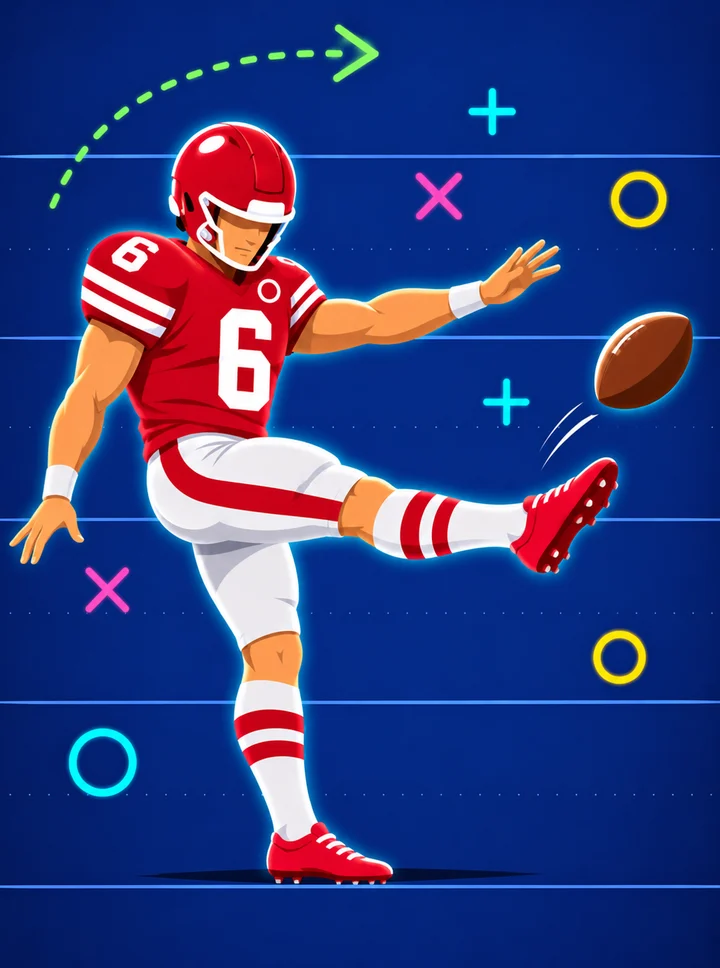
What he does
- Stands about 15 yards behind the line of scrimmage and catches the long snap
- Drops the ball and kicks it before it touches the ground, in about two seconds
- Chooses the kind of punt: long for distance, high for hang time so the coverage can arrive, or short to pin the team near its goal line
- Aims the ball toward a sideline to limit the returner’s space
- Works with the gunners, the fast players who run down the sidelines to tackle the returner
- Sometimes runs or throws on a fake punt when the coach calls for it
On punts
The punter takes the snap, takes one or two steps, and drops the ball onto his foot. A good punt has both distance and hang time, because a ball that stays in the air for about four seconds or more lets the gunners reach the returner before he can gain yards.
On special situations
Near the opponent’s goal line, the punter may try a coffin-corner punt, aimed at the sideline close to the end zone, so that the ball goes out of bounds near the goal line. Against a dangerous returner he may kick the ball out of bounds or use a short punt that lands before the returner can reach it.
What makes a good one
Consistency and a quick, clean motion matter most. A punter must be able to catch a bad snap and still get the kick off, and to change the type of punt for the field position and the wind.
How he lines up
The punter lines up about 15 yards behind the line of scrimmage, with a personal protector in front of him. Seven blockers form the line, and two gunners stand at the edges. He catches the snap at waist height and takes his steps while the line holds off the rush.
Techniques and common mistakes
Key techniques are catching the snap cleanly, a steady drop of the ball, hitting it on the instep and following through. A rugby-style punt rolls to the side, while a standard punt goes straight. Common mistakes are a low snap that delays the kick, dropping the ball at the wrong angle so that it is shanked, and kicking before the protection is set, which can lead to a block.
Animated play
Blue circles are the team with the ball. X marks the other team. The yellow oval is the ball.
- On fourth down, with too far to go and too far from the goal for a field goal, the offense punts.
- The long snapper throws the ball back about 14 yards to the punter.
- The punter drops it and kicks it before it touches the ground. A good punt flies around 45 yards.
- Two fast players called gunners race down the sides to tackle the returner.
- The receiving team catches the ball and starts its drive from where the returner is stopped.