Offensive guard
The two guards line up on either side of the center. They are interior blockers who work in tight spaces right in front of the quarterback, and they are the linemen most often asked to pull on running plays.
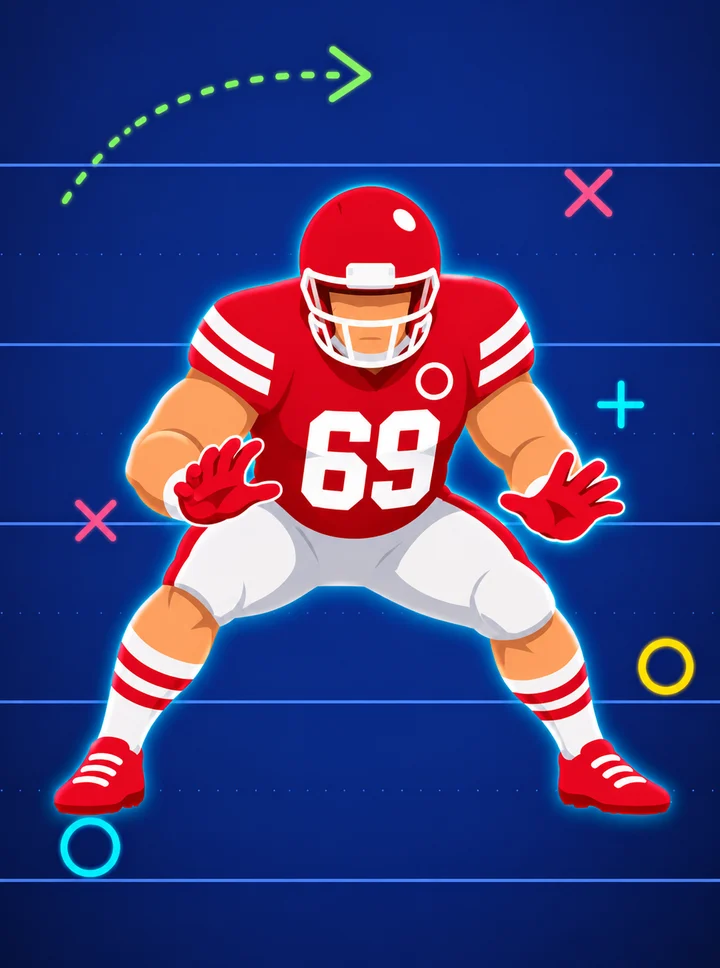
What he does
- Blocks defensive tackles and linebackers on running plays
- Pulls on gap plays, running along the line to lead the ball carrier through the hole
- Helps the center with double teams
- Keeps interior rushers away from the quarterback
- Communicates with the tackle and center on stunts and blitzes
On running plays
On a power run a guard pulls: he leaves his spot, runs across the line and blocks the first defender he meets at the point of attack. On zone plays he steps with the line and takes the defender in his area, or helps with a double team and then climbs to a linebacker.
On passing plays
Stays inside and sets a strong base so the pocket cannot collapse from the middle. He must handle stunts, where two rushers switch gaps, and pass the defender to a teammate at the right moment.
What makes a good one
Strength, quick feet in tight space and good hand placement. Athletic guards who can pull and block on the move are especially valuable.
How he lines up
Guards line up on both sides of the center, usually with a tight split so the interior has no gaps. On a pull play the guard’s depth and first step matter, since he must clear the line before the defense reacts. In a tight formation, a guard may line up next to a tight end, which changes which defender he blocks.
Techniques and common mistakes
Key techniques are the double team, the pull, the trap block, where a guard blocks a defender who is allowed across the line, and the pass set with a short, balanced base. Common mistakes are chasing the defender’s hands instead of his body, a pull that arrives late or too high, and not passing off a stunt, which gives the other rusher a free lane.
Animated play
Blue circles are the team with the ball. X marks the other team. The yellow oval is the ball.
- The guard lines up between the center and the tackle, and most of the time he blocks the defender in front of him.
- On some plays he does the opposite. At the snap he drops back and runs along the line. This is called pulling.
- He runs ahead of the ball carrier and becomes his escort. He finds the first defender and blocks him.
- With that defender out of the way, the runner can turn the corner and gain more yards.