Tight end
The tight end lines up next to the offensive tackle and plays two roles at once. He is part of the line when he blocks, and a pass catcher when he runs a route.
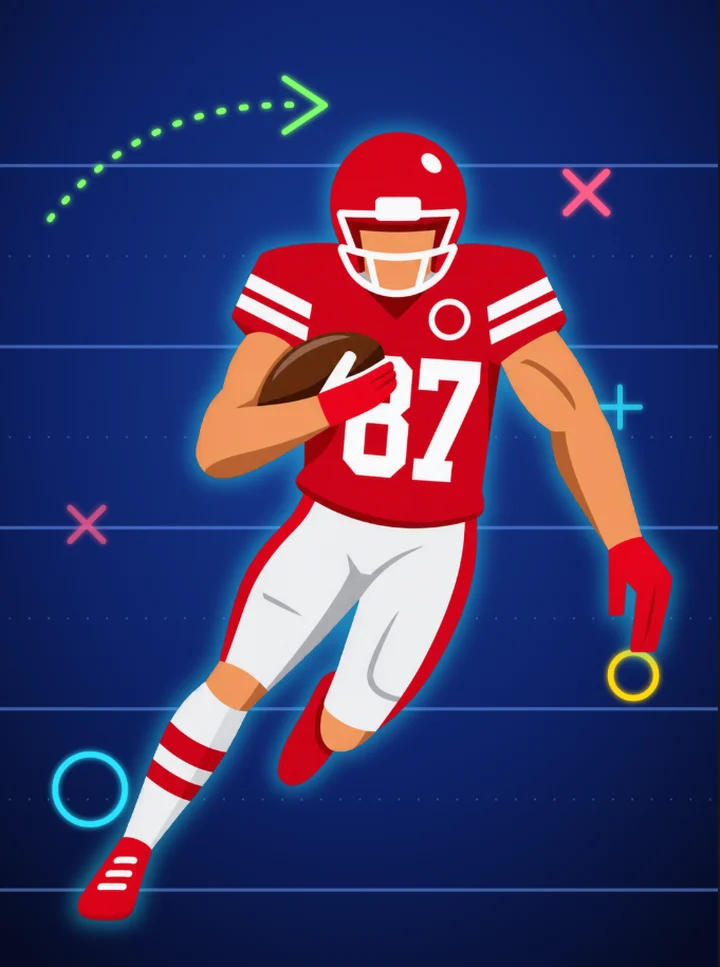
What he does
- Blocks defensive ends and linebackers on running plays
- Stays in to protect the quarterback or helps a tackle
- Runs seam, out and crossing routes
- Lines up in different places (on the line, in the slot, in the backfield) to give the defense problems
- Serves as a safety valve for the quarterback on short throws
On running plays
Seals the edge or leads through a hole as a blocker. A good blocking tight end is like a sixth lineman.
On passing plays
Attacks the middle of the field on a seam, finds soft spots in a zone, or uses his size against smaller defensive backs. He is a problem for defenses because linebackers can be slow to cover him and safeties are often smaller.
What makes a good one
Size and strength to block, hands and body control to catch. Players who do both well are highly valued.
How he lines up
The tight end lines up beside the tackle, in the slot, split wide or in the backfield, and the choice tells the defense little because he can do both jobs. A tight end attached to the line suggests a run, while one split out suggests a pass. Two tight ends on the field create strength on both sides of the formation and force the defense to choose between bigger players and faster ones.
Techniques and common mistakes
Key techniques are the down block on a defensive end, the reach block that seals an edge, the release against a jam, and boxing out a defender to protect the ball in tight coverage. Common mistakes include being too slow off the ball against edge rushers, giving up pressure by missing a chip block, and running seam routes without reading the safeties’ positions.
Animated play
Blue circles are the team with the ball. X marks the other team. The yellow oval is the ball.
- The tight end lines up at the end of the offensive line, so he can either block or go out for a pass.
- On a pass play he runs straight up the middle of the field. This route is called a seam.
- A linebacker is usually too slow to cover him, and a safety is usually too small to stop him, so he finds a gap between them.
- The quarterback throws over the linebacker and the tight end catches the ball. On other plays he stays in to block like a lineman.