Safety
Safeties are the deepest defenders and the last chance to stop a big play. The free safety usually plays deeper, and the strong safety plays closer to the line, often near the tight end.
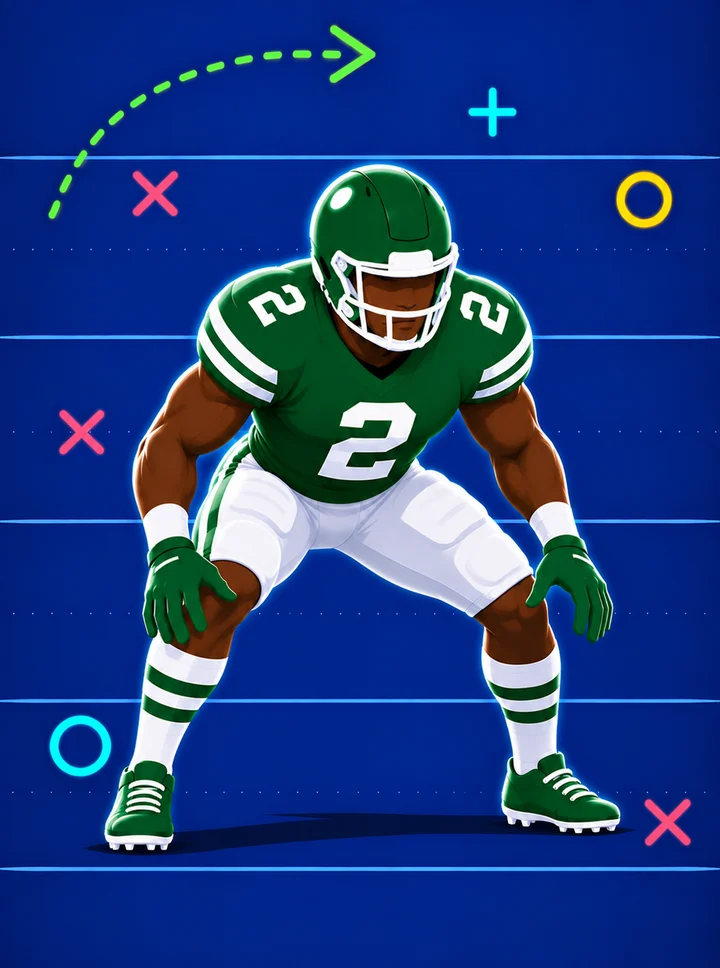
What he does
- Plays a deep half, third or quarter depending on the coverage
- Helps the corner against deep routes
- Comes up to stop the run if the runner breaks through
- Covers tight ends and slot receivers in some packages
- Calls out the coverage and shifts to the rest of the defense
Types of safety
Free safety (FS)
The free safety is the deepest defender, with the most freedom to read the quarterback and help wherever he is needed. He usually lines up farthest from the line of scrimmage.
- Plays the deep middle or a deep half, depending on the coverage
- Reads the quarterback’s eyes and breaks on the ball for interceptions
- Helps the cornerbacks against deep routes
- Tackles the runner in the open field if he gets past the front
Strong safety (SS)
The strong safety plays closer to the line, on the side where the tight end lines up. He is usually bigger and a better tackler than the free safety.
- Acts as an extra run defender near the line, almost like a linebacker
- Covers the tight end and slot receivers in many calls
- Blitzes from the secondary
- Takes a deep half in a split-safety coverage such as Cover 2
On running plays
Reads the run quickly and comes downhill to tackle. The strong safety often acts as an extra run defender near the line.
On passing plays
In Cover 2 each safety takes half of the field deep. In Cover 3 the free safety takes the middle third. Showing one look before the snap, then rotating after it, makes the quarterback guess.
What makes a good one
Range, tackling, quick reads and communication.
How he lines up
Safeties line up 10 to 15 yards deep, and their alignment is the most important clue for the quarterback. Two deep safeties suggest Cover 2 or Cover 4, and a single deep safety suggests Cover 1 or Cover 3. Good defenses disguise it: both safeties show a deep alignment and one drops toward the line right before the snap, or the other way round.
Techniques and common mistakes
Key techniques are a smooth backpedal, breaking at the right angle to the ball, tackling the runner in open space and communicating the call to the rest of the secondary. Common mistakes are biting on a play-action fake, taking a bad angle on a long run, running into a teammate on a deep ball and leaving the deep zone to follow the ball.
Animated play
Blue circles are the team with the ball. X marks the other team. The yellow oval is the ball.
- The safety is the last line of defense. He stands deep, behind all other defenders.
- He keeps his eyes on the quarterback and reads the offense, because he can see the whole field from there.
- When the quarterback throws, the safety already knows the route. He runs to the spot where the ball will land.
- He gets there first and catches the ball. That is an interception, and the other team now has the ball.