Receiver
Wide receivers line up near the sidelines and are the main targets in the passing game. X is the receiver on the line of scrimmage, Z lines up a step behind it, and the slot receiver works between the line and the outside receiver.
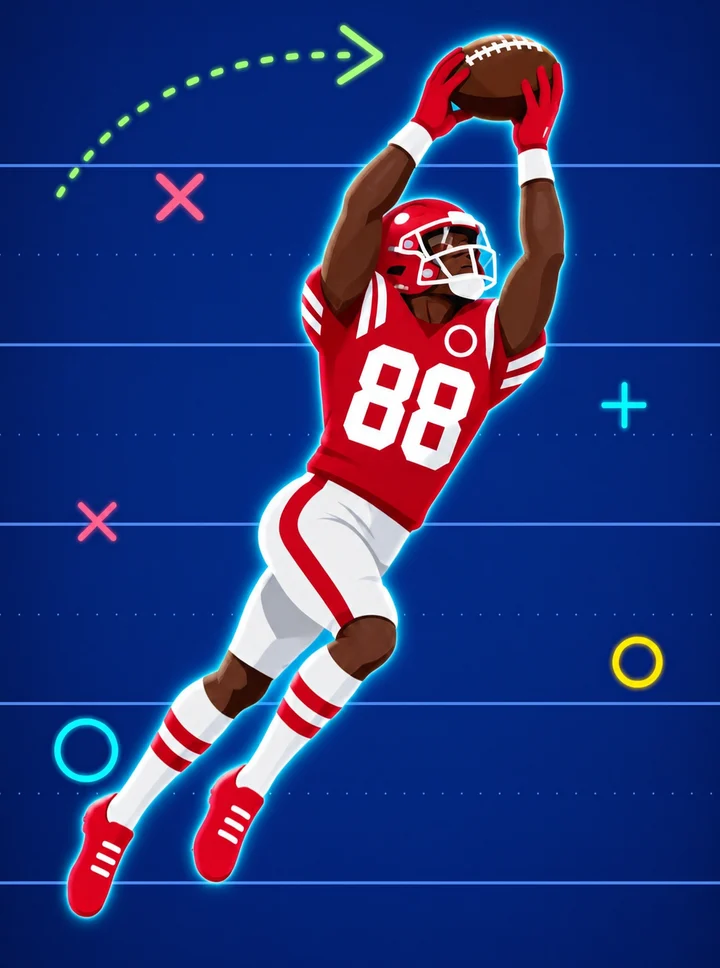
What he does
- Runs the route called in the play: go, curl, slant, post, out and others
- Gets off the line of scrimmage against press coverage
- Catches the ball in traffic and holds it through contact
- Gains yards after the catch
- Blocks cornerbacks and safeties on running plays and screens
Types of receiver
Wide receiver (X and Z)
Wide receivers line up near the sidelines. The X receiver (split end) lines up on the line of scrimmage, and the Z receiver (flanker) lines up a step behind it, which lets him avoid the jam at the line and move before the snap.
- Runs deep and intermediate routes, such as go, post, out and comeback routes
- Beats press coverage with a quick release off the line
- Uses speed and size to win one-on-one against cornerbacks
- Blocks downfield on runs and screens
Slot receiver
The slot receiver lines up between the offensive line and the outside receiver, a step off the line of scrimmage. He is usually smaller and quicker than the outside receivers.
- Runs short and crossing routes over the middle, often against linebackers
- Finds the soft spots in zone coverage
- Is a reliable target on third down, since he works close to the quarterback
- Blocks in the run game and on screens near the line
On running plays
Blocks the defender in front of him, usually a cornerback, to keep the run going outside. A good block can turn a short gain into a long one.
On passing plays
Breaks off his route at the planned depth and moment so the quarterback can throw before the receiver turns. If the first look is covered, he adjusts the route to the coverage (a hot route or option route).
What makes a good one
Speed, quick feet, strong hands and route precision. The slot receiver is usually smaller and quicker, built to beat a defender in short space.
How he lines up
Receivers use splits, the distance between them and the nearest lineman, to control spacing. A wide split gives a cornerback more room and stretches the defense across the field. Receivers may line up on the line of scrimmage, off it, or go in motion before the snap. Motion lets the offense see whether the defense is playing man or zone, because a defender who follows the receiver across the formation is likely in man coverage.
Techniques and common mistakes
Important techniques are the release at the line, a clean stem (the first part of the route), a sharp break, tracking the ball over the shoulder and securing it before turning upfield. The most common mistakes are rounding off a break, which lets the defender catch up, drifting toward the sideline, dropping the ball while looking for yards, and running the wrong depth so the quarterback’s timing is thrown off.
Animated play
Blue circles are the team with the ball. X marks the other team. The yellow oval is the ball.
- The receiver lines up near the sideline. A cornerback is across from him.
- At the snap he runs a route, which is a path planned in advance. He runs straight at first, then makes a sharp cut toward the middle of the field.
- The cut is meant to get him a step ahead of the defender, who has to guess where he is going.
- The quarterback throws the ball to the spot where the receiver will be. He catches it and tries to gain more yards after the catch.